
Anatomy of a Good Presentation: Balancing content and delivery for maximum impact
Read time (Approx 9 min read)
Executive Summary
Presentations are one of the most powerful ways to inform, influence, and inspire. Yet, many fall flat because presenters either overload audiences with information or impress the audience with flair while offering little substance.
This article introduces a simple but powerful framework—the 2×2 Presentation Matrix—which examines presentations along two pillars: Content (what you say) and Delivery (how you say it). The framework reveals four distinct types of presentations: High Impact, Lost Opportunity, Style over Substance, and Complete Failure.
Drawing from over two decades of corporate and training room experience and examples from business, education, and public life, this article explores the anatomy of a good presentation. It outlines practical parameters for content and delivery, highlights how the two pillars interact, and offers strategies to consistently aim for the gold standard: High Impact presentation*.
*Sidenote: The principles in this article apply not only to corporate boardrooms but also to virtual meetings, community gatherings, family events, and even social occasions where public speaking is required.
1. Why Presentations Matter More Than Ever
Presentations are more than slides and speeches—they are the medium of influence in today’s organizations and communities. Whether it’s pitching for a new product, updating the company board, motivating a team, or sharing knowledge as a subject matter expert, presentations shape how ideas are received and whether they lead to action.
Despite their importance, many presentations fail. Some are overloaded with information but delivered lifelessly. Others are entertaining but empty, offering little takeaway. Rarely do we see a presentation that balances substance with style.
A good presentation is not an accident. It is a craft—shaped by balancing two critical pillars: Content and Delivery.
2. The Two Pillars: Content and Delivery
Every presentation rests on two foundational pillars:
what you say (Content) and how you say it (Delivery).
Neglect either, and the presentation risks collapse. (Figure 1)
Content: What Makes It Strong
Good content is more than information—it must connect with the audience and flow logically. Three essential parameters define strong content:
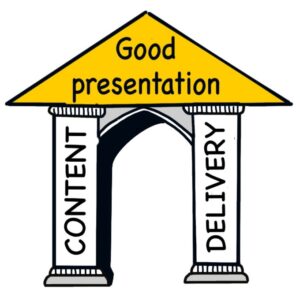
Figure 1: The Two Pillars of a Presentation
- Relevance for the audience
Guideline: Is my narrative audience-centric? Find out about the audience in advance. Enlist what you can offer in your speech that the audience will benefit and motivate from.
Example: A finance leader explaining returns on investment in terms of business impact, not accounting jargon.
- Clear and logical flow
Guideline: How do different parts of my speech relate to each other? Where do I start, and with what do I close?
Even a 2-minute talk benefits from a skeleton structure—it helps the speaker stay on track and the audience to remember.
Example: Structuring a client pitch as Problem → Solution → Impact instead of jumping randomly.
- Engagement elements
Guideline: Is my narrative interesting and easy to stick? Relevant content and good flow are necessary, but not sufficient to make it memorable. To truly leave an impact, the content must be enriched with metaphor, examples, numbers, quotes, stories. The relevant content is just the cake, these engagement elements are candles, bells, and whistles.
Example: Using a sport analogy to explain need for teamwork or citing a well-known quote.
Delivery: What Brings It Alive
As one saying goes: “The two most difficult tasks in the world are: 1) transferring money from another person’s pocket to your own, and 2) transferring an idea from your head to another person’s head.”
Delivery is the bridge that transfers your ideas to the audience. It can be understood through the 3Vs framework (Figure 2):
- Visual (body language, gestures, eye contact, smile)
Example: A warm smile and steady eye contact instantly build trust.
- Vocal (voice, tone, modulation, speed, pauses)
Example: Pausing after an important point — “So what does this mean for us?” — gives your audience time to think and absorb.
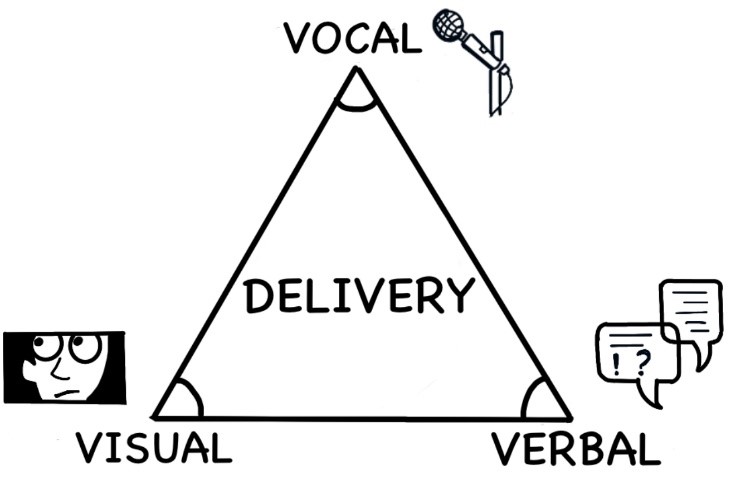
Figure 2: The 3Vs of Delivery
- Verbal (choice of words, clarity, simplicity)
Example: Short, simple sentences land better than jargon-filled monologues.
Within these 3Vs, five practical delivery parameters stand out:
- Loud and clear voice
- Smile and eye contact
- Speaking at a good pace
- Purposeful gestures
- Voice modulation
When these are tuned well, delivery amplifies the impact of content.
3. The 2×2 Presentation Matrix
Visualize a grid with Content on the vertical axis and Delivery on the horizontal axis. Each can be High or Low, creating four quadrants (Figure 3):
- Top-right: High Content + High Delivery → High Impact
- Top-left: High Content + Low Delivery → Lost Opportunity
- Bottom-left: Low Content + Low Delivery → Failure
- Bottom-right: Low Content + High Delivery → Style over Substance
The matrix flows anticlockwise—a reminder that presentations can easily spiral downwards if either pillar is ignored.
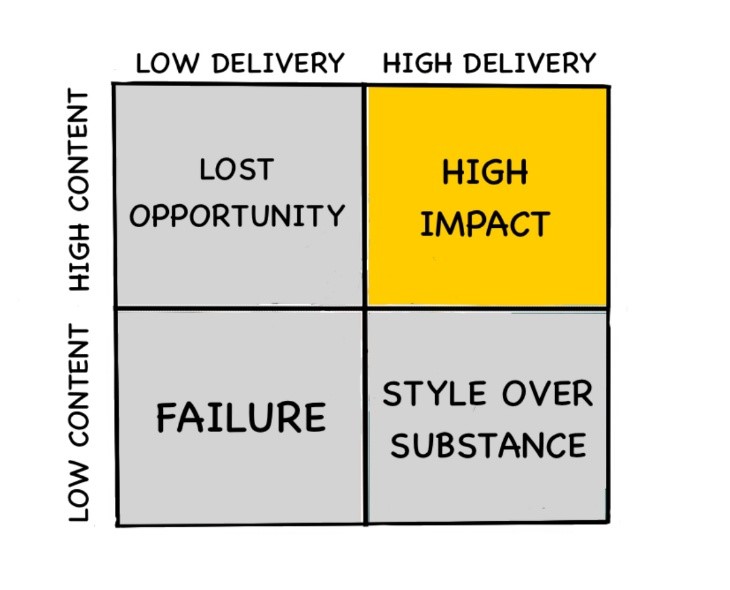
Figure 3: The 2×2 Presentation Matrix
4. Dissecting the Four Quadrants
Quadrant 1: High Impact (High Content + High Delivery)This is the gold standard—presentations that inform, influence and inspire. They use simple language, relatable metaphors, and strong delivery techniques such as pauses, gestures, and humor.
Examples:
- Steve Jobs unveiling the iPhone (2007): A masterclass in simplicity and storytelling—clear structure, crisp visuals, and conversational delivery that made technology feel human.
- Sir Ken Robinson’s TED Talk on Do Schools Kill Creativity? Blended humor, empathy, and insight to redefine how audiences think about education and innovation.
- Barack Obama’s 2004 Democratic Convention Keynote: Balanced content and emotion with authenticity and pacing, inspiring belief through clarity of message.
The secret? The two Ps: prepared content and practiced delivery. Great presenters collect material, refine it, rehearse it, and often do test runs or record themselves. As Mark Twain famously said, “It takes me a week to deliver a good impromptu speech.”
Quadrant 2: Lost Opportunity (High Content + Low Delivery)
Strong ideas with weak delivery leave audiences unmoved. They start attentively but soon disengage as monotone voices, jargon, or lack of warmth take over.
Examples:
- Research conferences where brilliant minds read from slides in monotone, leaving their insights lost in delivery fatigue.
- Corporate leaders who are subject-matter experts but speak in jargon-heavy language, disconnecting from their audience’s reality.
- Academic lecturers whose depth of content is unquestionable, but lack of modulation or engagement causes students to tune out.
The fix? Simplify content and practise delivery. Even strong content deserves a dry run to ensure clarity and energy.
Quadrant 3: Style over Substance (Low Content + High Delivery)
This quadrant is the most deceptive of the four. The presentation feels lively, engaging, even electrifying — yet offers little real value. Audiences enjoy the experience, but when the excitement fades, few can recall the key message or apply anything meaningful.
The euphoria trap: Among the less effective quadrants, this one is the hardest for presenters to be self-aware about. Because the immediate response is often positive — applause, laughter, praise — presenters can easily mistake energy for impact. The presentation feels successful, even though it may have achieved only temporary engagement, not lasting change.
Examples:
- Motivational talks that energize audiences with stories and humor but lack a clear, actionable message.
- Team-building sessions that are full of fun activities yet fail to connect back to workplace objectives.
- Political speeches that soar in delivery and theatrics but offer little substance beyond slogans.
The risk? The purpose of the presentation is lost. The fix is simple: Research content and anchor delivery in substance. Identify five questions the audience wants answered or three points you must deliver. Strong delivery can open the door — but only strong content makes people walk through it.
Quadrant 4: Complete Failure (Low Content + Low Delivery)
This is the disaster zone. The audience feels their time was wasted—sometimes even abused. Both the speaker and their organization, department, or unit suffer reputational damage.
Examples:
- Unprepared presenters reading verbatim from slides, showing neither structure nor sincerity.
- Ceremonial speeches where the speaker appears disengaged and the audience is visibly restless.
- Routine updates delivered without clarity, enthusiasm, or direction, leaving the audience confused or indifferent.
The fix? Preparation and humility are key. Say no to opportunities you’re not ready for rather than risk reputational harm. Even a little preparation goes a long way.
5. Beyond the Matrix: The Interdependence of Content and Delivery
Though the matrix separates the two, content and delivery are intertwined. Strong content often improves delivery—clear ideas give confidence. Likewise, natural delivery can temporarily mask weak content, though not for long.
A useful metaphor is Product and Packaging (Figure 4):
- Content is the product—without it, there is no value.
- Delivery is the packaging—without it, the value is hidden.Both must work together.
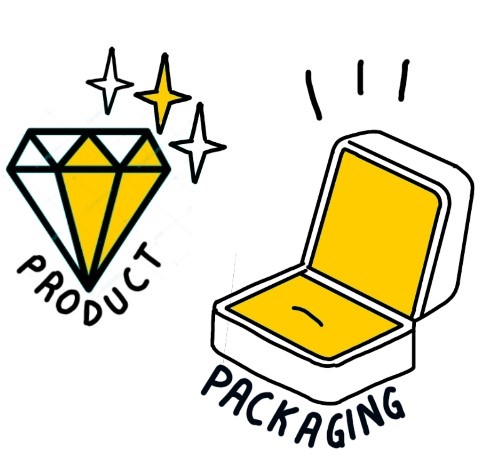
Figure 4: Product and Packaging Metaphor
6. The Non-Negotiables: Aiming for High Impact
How can professionals consistently land in the High Impact quadrant? Three non-negotiables stand out:
- Start with the audience: Shape everything around their needs.
- Build clear content: Three points, one story, and supporting evidence is a proven recipe.
- Rehearse delivery: Record, review, refine—and always do a dry run.
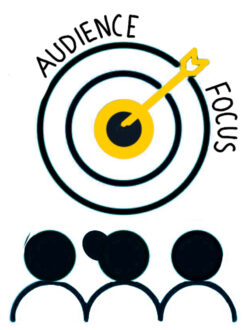
Figure 5: Audience Focus
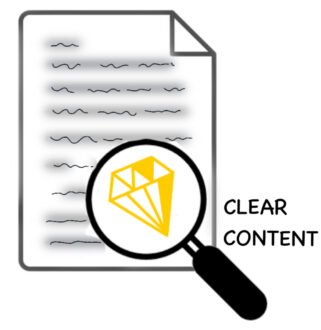
Figure 6: Clear Content
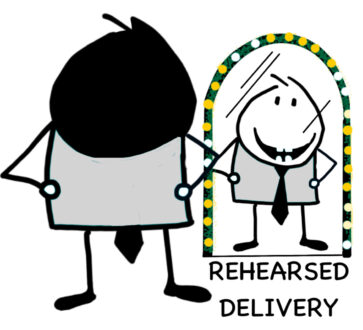
Figure 7: Rehearse delivery
Content is easier than ever thanks to online resources. Delivery has no shortcut. For most people, it is harder than content—but practicing is easier than ever with tools like phone cameras and audio recorders. Seeking a coach can also accelerate growth.
7. Practical Pointers and Common Challenges
- Nervousness: Manageable through preparation, rehearsal, and feedback.
- Slides: Keep them simple—support the message, don’t drown it.
- Props: Use props with purpose. For example, a flip-chart can be powerful when used to sketch a model live. Choose props for clarity, not decoration.
- Questions: A lot of us feel nervous about presentations, because we dread difficult questions. Hoping that no one will ask difficult question is futile. Anticipate likely questions and rehearse responses.
Each of these deserves deeper exploration, but even brief attention helps avoid common pitfalls.
8. Presentations in the Hybrid Era
In hybrid and virtual settings, delivery challenges multiply: eye contact is harder, gestures restricted, and energy more difficult to sustain. Clarity of content becomes even more vital.
Tips include looking into the camera to simulate eye contact, using vocal variety more deliberately, and designing slides with stronger visual cues. The principles remain timeless, but techniques must adapt (Figure 8).
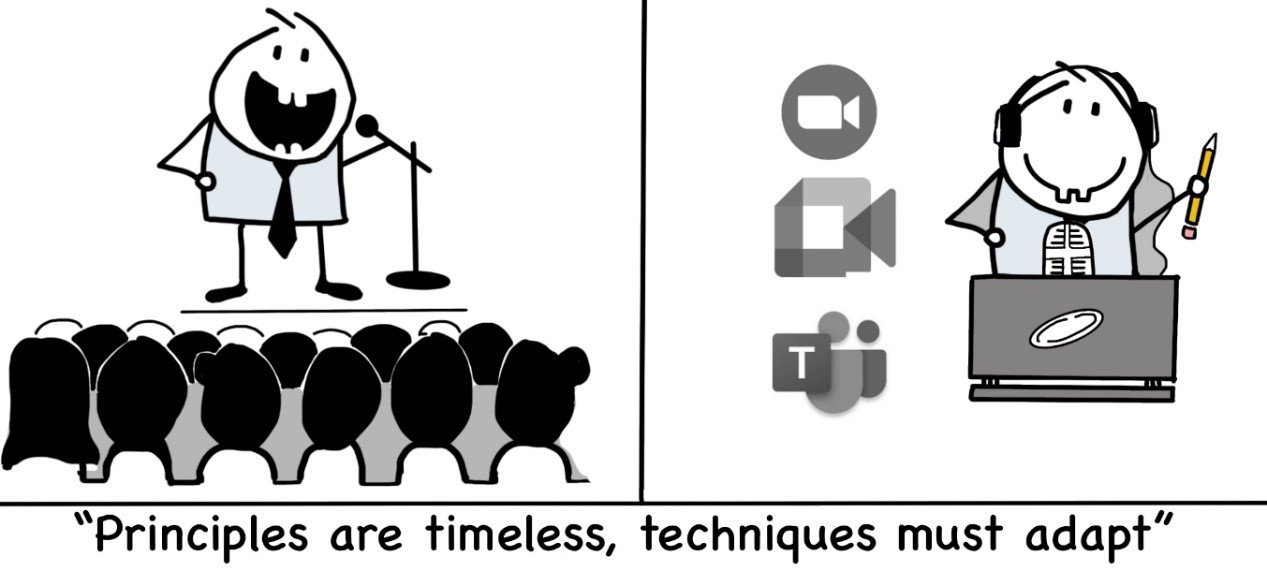
Figure 8: Presenting in-person or online
9. Conclusion: The Craft Behind the Art
- A good presentation is not a gift of nature—it is a craft. Like any craft, it requires balancing both substance and style. Content provides value; delivery ensures that value is received.Next time you present, ask yourself: Does it have both substance and style? If yes, you are in the High Impact quadrant—the place where presentations don’t just inform, but influence and inspire.
10. Further Learning
Notable High-Impact Presentations
- Steve Jobs unveils the iPhone (2007) > Watch on YouTube
- Sir Ken Robinson: Do Schools Kill Creativity? > Watch on TED
- Barack Obama’s 2004 Democratic Convention Keynote > Watch on YouTube